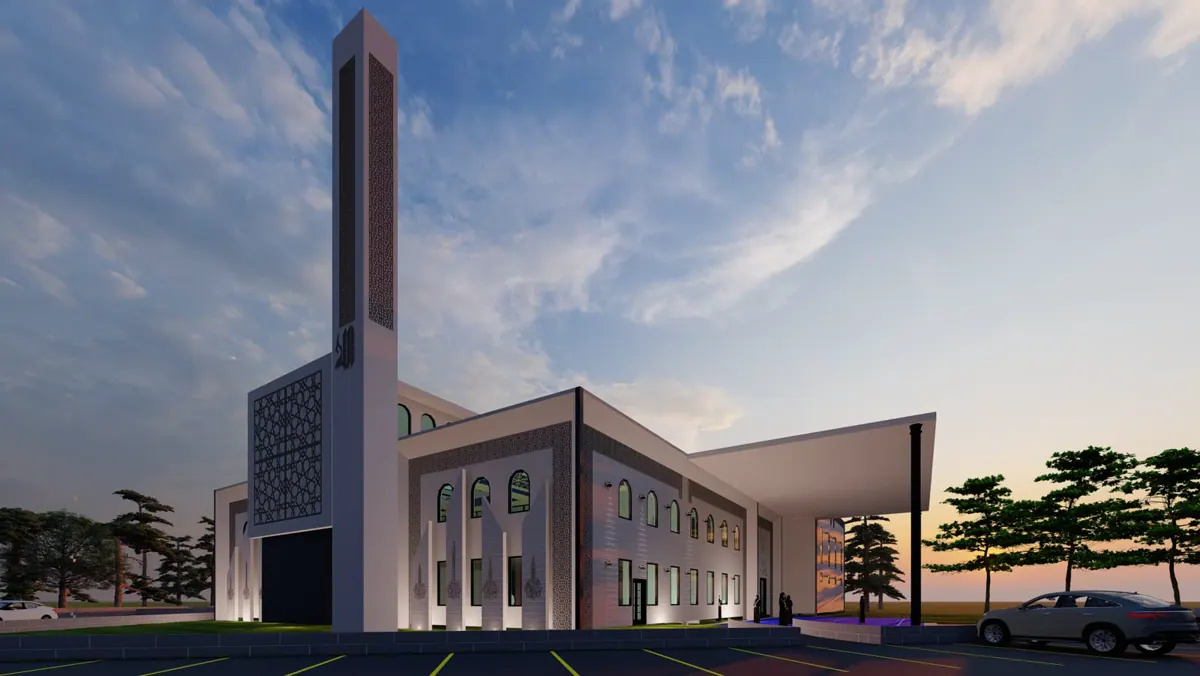




Once residents understand the size of Princeton Islamic Center’s proposed mosque, the next question is obvious.
Who is paying for it?
That question will make some people uncomfortable. It should still be asked.
PIC’s campaign has framed the project as a major new masjid for Princeton and surrounding communities, with a goal around $6 million and a vision that includes an 800-plus worshipper prayer hall, classrooms, youth spaces, community areas, recreation, overflow space, and parking.
That makes the funding question public-interest news.
Not because donation is suspicious by itself. Churches, schools, nonprofits, campaigns, and civic groups raise money every day.
Because a project this large can change traffic, land use, institutional power, and the regional identity of northeast Collin County.
Money shows seriousness, reach, urgency, and who has enough confidence in Princeton’s future to invest in it.
Quick Read
- Princeton Islamic Center is raising money for a major mosque and community center project.
- The scale of the project makes funding transparency important.
- The campaign page lists a $6 million total goal, a $1.8 million Phase 1 goal, and an $800,000 Phase 1 kick-start target.
- Residents should know how much has been raised, how much is still needed, whether the money is local, and what commitments are tied to it.
- Nonprofit religious fundraising is normal, but major regional projects deserve clear public context.
- The funding question is one part of the bigger question: how quickly is Princeton becoming a regional institutional hub?
What Residents Can Verify
The public can verify several basic facts.
Princeton Islamic Center lists itself at 521 N. 4th Street and says it was established in November 2019 to serve Muslim families in Princeton and surrounding areas.
Its new masjid campaign has described a much larger future facility. Collin County Journal previously reported the planned site at 943 County Road 456, inside Princeton’s growth area and ETJ.
The campaign materials describe a vision far beyond a small prayer space.
The public fundraising structure is also specific. PIC lists a $6 million total goal, a $1.8 million Phase 1 goal for site work, foundation, and steel structure, and an $800,000 kick-start target. It also presents donation tiers such as $1,500 “brick” gifts and larger room sponsorships.
What residents cannot easily verify from a simple public glance is the full funding chain: donor mix, major donors, local versus out-of-area money, financing structure, construction timing, debt, contractor arrangements, and whether outside institutions or networks are materially driving the project.
Those are fair questions.
Why The Money Matters
Money reveals momentum.
A project can have renderings and still go nowhere. A project with major fundraising, land direction, organized leadership, and community urgency is different.
Funding also reveals whether a project is mostly a local congregation trying to build for its own members, or whether the effort is becoming a regional buildout supported by a much wider network.
That distinction changes how residents understand the whole story.
That distinction matters to residents trying to understand future traffic, community influence, and institutional permanence.
The Standard Should Be Simple
No one should have to guess.
If a $6 million religious and community center is planned inside a fast-growing city’s future development area, the public conversation should include clear answers.
How much has been raised? How much remains? Is the land secured? Are large gifts coming from inside Princeton, greater DFW, national donors, or international sources? Are there loans? Are there naming commitments? What phase would come first? What happens if fundraising slows?
That does not require hostility. It requires transparency.
What This Says About Princeton
Princeton is now attractive enough for major institutions to plan around it.
That is the upside and the problem at the same time. Growth brings investment. Investment brings projects. Projects bring permanence. Permanence changes what a place feels like.
Residents who bought into Princeton for space, small-town life, and a familiar local rhythm are watching the future arrive through rooftops, schools, roads, retail, and now major religious infrastructure.
They are allowed to ask who is shaping it.
Bottom Line
The funding question is not a side issue.
It is one of the clearest ways to understand whether the Princeton mosque is a local congregation’s next step or a broader regional project with deeper roots, larger ambitions, and more staying power than residents realize.
If the project is good for Princeton, sunlight helps prove it.
Sources: Princeton Islamic Center campaign page, Princeton Islamic Center new masjid page, Princeton Islamic Center website, Collin County Journal’s original reporting, and 943 County Road 456 property listing data.