



The paperwork says $12 million.
The politics say much more.
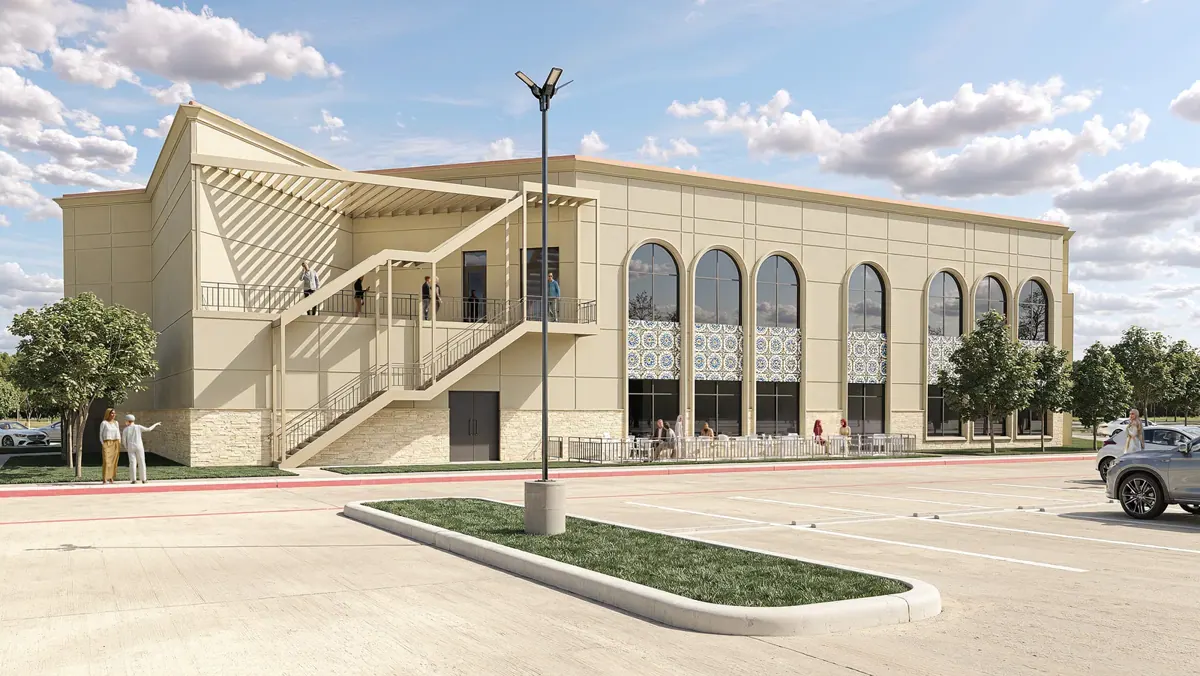
A Texas Department of Licensing and Regulation filing lists the Islamic Center of Quad Cities project near Lebanon Road and Batsford Drive in Frisco as a $12 million privately funded mosque construction project on private land.
The filing describes a two-story, 43,575-square-foot facility with prayer halls, classrooms, restrooms, wudu stations, a gymnasium and other areas.
Those are the hard facts.
Then came the public fight.
Frisco’s mosque and temple debate turned an administrative development file into one of the city’s loudest identity battles of 2026.
Quick Read
- TDLR records list the Islamic Center of Quad Cities project at Lebanon Road and Batsford Drive.
- The estimated cost is $12 million.
- The project is listed as privately funded, on private land, for private use.
- The filing describes a two-story, 43,575-square-foot mosque.
- The scope includes prayer halls, classrooms, restrooms, wudu stations and a gymnasium.
- The state record lists the project as TABS2024006321, registered on Nov. 30, 2023.
- The TDLR page lists the current status as “Review Complete.”
- The project became part of a larger Frisco fight over traffic, land use, religion, demographics and public process.
The Official Record Gives Residents A Starting Point
The TDLR filing matters because it gives residents something firmer than rumor.
The project number is TABS2024006321. The registration date is Nov. 30, 2023. The listed location is Lebanon Road and Batsford Drive in Frisco. The estimated cost is $12 million. The square footage is 43,575. The listed type of work is new construction. The listed funding type is private funds, private land and private use.
That does not answer every local question.
It does not tell residents how many people could be on site during peak prayer times, major events, school activity, gym use, weekend classes or holiday periods.
It does not settle traffic impact.
It does not settle parking demand.
It does not settle neighborhood fit.
It does not tell residents whether surrounding roads, turn lanes, access points, drainage, emergency access and event management are ready for the real-world version of the project.
That is the first place the public conversation should start.
The filing proves the project is real, large and far beyond a small neighborhood prayer room. It does not prove the city has answered the practical questions residents will live with.
The File Is Technical. The Reaction Was Not.
City development files are usually boring until they hit a nerve.
This one hit several.
The $12 million mosque project became part of a broader Frisco debate that included site plans, public comments, religious-facility approvals, Hindu temple proposals, traffic concerns, zoning limits and whether residents believe City Hall has enough control over the city’s future.
Supporters see lawful private development.
Opponents see cultural change, traffic pressure, religious expansion and a city that keeps telling residents what it cannot do after the process is already too far along.
That gap is why the room exploded.
The Money Gives The Project Scale
$12 million is not a small community room.
A 43,575-square-foot two-story facility is a major project.
The size matters because residents do not experience land use as paperwork. They experience it as cars, school pressure, weekend traffic, neighborhood change, parking patterns, event activity, and a different feel around the roads they use every day.
That is why city leaders should never treat controversial development as merely technical.
A project can be lawful and still politically explosive.
A project can be privately funded and still affect public roads.
A project can comply with rules and still make residents ask whether the rules are producing the future they want.
What The Filing Does Not Price In
The $12 million figure is construction cost.
It is not the full civic cost.
A private project can still create public questions.
If the facility adds peak-hour turns, weekend surges, event traffic, overflow parking, pedestrian movement, police calls, fire access needs or drainage questions, those effects do not stay inside the property line.
That is why residents should not stop at the construction estimate.
They should ask for the practical ledger.
How many parking spaces are required and how many are provided?
What peak-use assumptions were used?
What roads carry the traffic?
What happens during major religious events?
Are there school, classroom, gym or community-event uses that change the traffic pattern beyond normal prayer times?
What emergency access routes are protected?
What conditions, if any, can the city still enforce?
That is the value residents need from local coverage. The headline says “$12 million mosque.” The actual resident question is whether the surrounding infrastructure and rules match the intensity of use.
The Legal Side Controls The Fight
This is where residents need to be precise.
City government does not have unlimited power to block religious land use because people dislike the religion attached to the project.
Federal law, zoning rules, property rights and neutral development standards all limit what a city can do.
That does not mean residents should be quiet.
It means the strongest objections have to be built around the parts government can actually measure: traffic, parking, drainage, access, emergency response, site compliance and whether the process followed the law.
If residents believe the rules make these projects too easy to approve, then the fight is larger than Frisco City Council.
It is a fight over the legal framework itself.
That distinction matters because anger aimed at the wrong target burns energy without changing the outcome.
If a project meets the legal standard, a council may have limited room to maneuver. If residents believe the legal standard is wrong, vague, too weak or too deferential to certain uses, then the real fight moves to ordinances, state law, federal law, development standards and future elections.
That is less satisfying than shouting at a meeting.
It is also more serious.
The Cultural Question Will Not Vanish
Frisco leaders can explain the law.
They cannot explain away the cultural question.
Residents are watching a city change fast. New religious institutions, new immigrant communities, new political fights, packed meetings, public-comment changes and a mayoral runoff are all happening inside the same atmosphere.
That is why one development file became a citywide flashpoint.
People are arguing over the building and the city forming around it.
They are arguing over who Frisco is becoming.
City leaders may want to narrow the discussion to procedure.
Residents are not experiencing it that way.
They are watching land use, culture, traffic and political power collide at the same time. They see a fast-growing city where official explanations often arrive after the anxiety has already hardened. That is how trust gets damaged.
The practical issue is the site.
The larger issue is whether residents believe Frisco still has a clear identity, a clear process and leaders willing to say plainly what can be controlled, what cannot be controlled and what they intend to do before the next fight arrives.
The City Hall Test
Frisco has a records system. Agendas, minutes, action summaries and videos are posted through the city’s meeting portal. The city says agendas are posted online at least three business days before meetings, and videos are usually posted within 24 hours when available.
That is useful.
But access to records is not the same thing as public understanding.
For an issue this charged, residents need more than a link and a legal explanation.
They need a clean public map of the decision chain.
What approvals were administrative?
What approvals required a public vote?
Which standards were mandatory?
Which standards involved judgment?
What did staff recommend?
What could council legally consider?
What could council not legally consider?
Which resident concerns were addressed through conditions, and which were outside the city’s legal reach?
That is the missing layer in most public fights.
Without it, residents fill the gap themselves. Some assume City Hall is hiding something. Others assume opponents are simply angry. The better answer is to put the process on the table in a way normal people can actually follow.
The Frisco Scorecard
Before this becomes another week of slogans, residents should demand a scorecard.
One: traffic. Show the peak assumptions, not just the average-day answer.
Two: parking. Show whether the site can handle ordinary use and major-event use without pushing pressure onto nearby streets.
Three: emergency access. Show how fire, police and ambulance access works when the site is active.
Four: drainage and utilities. Show whether the site adds stress to systems residents already pay to maintain.
Five: meeting transparency. Show every approval step in plain language, with the public record attached.
Six: legal limits. Say exactly what Frisco can regulate and what it cannot regulate.
Seven: future precedent. Explain whether similar religious, cultural, school or assembly uses would be treated the same way under the same rules.
That is the test.
If the project is legally solid and operationally sound, the scorecard should prove it.
If the scorecard exposes gaps, residents deserve to know that before the next development file becomes another citywide fight.
Bottom Line
The Islamic Center of Quad Cities filing gives Frisco residents the concrete numbers: $12 million, two stories, 43,575 square feet, private funds, private land.
The public fight gives the bigger lesson.
When a fast-growing city changes this quickly, every major development becomes more than a site plan.
It becomes a test of law, roads, culture, leadership, and whether residents believe they still have a meaningful voice before the outcome is already set.
Frisco should stop acting surprised when technical files become political fights.
That is what happens when growth outruns trust.
Sources: Texas Department of Licensing and Regulation project filing for Islamic Center of Quad Cities, Houston Chronicle reporting on the Frisco mosque meeting, Dallas Express reporting on the May 19 Frisco council meeting, and City of Frisco meeting records portal.