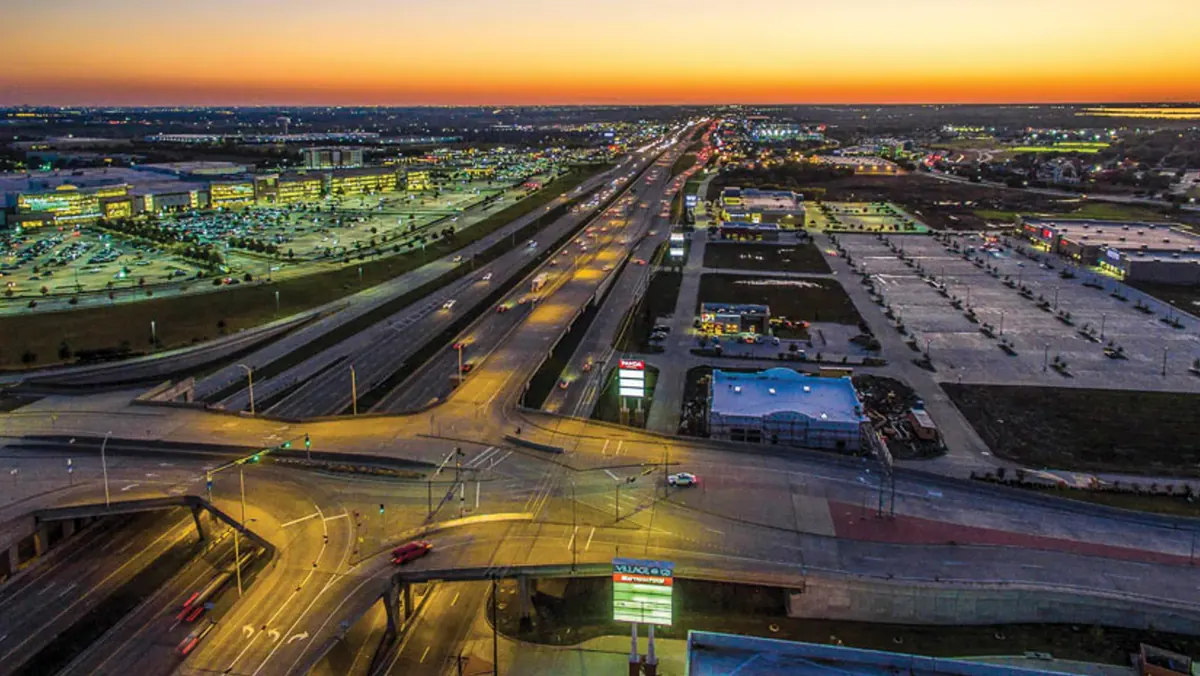




Allen and McKinney are not waiting for growth to happen to them.
They are packaging it, naming it, selling it, and telling the market exactly where to look.
The new 121 North initiative brands the SH 121 corridor as a shared economic-development engine between Allen and McKinney. Community Impact reported that more than 20 projects are planned or underway along the corridor.
That is the headline.
The numbers are the hook.
A $950 million Kalahari resort in Allen.
A $200 million Cannon Beach surf resort in McKinney.
Millions of square feet of office, retail, industrial, hotel, restaurant, entertainment, and residential space lining the same road.
This is no longer a highway.
It is becoming a development spine.
And when CCJ added up the named projects in the public project list, the scale became clearer.
At minimum, the listed corridor projects point to more than 11 million square feet of office, tech flex, and industrial space, roughly 800,000-plus square feet of retail and restaurant space, more than 9,000 urban residential units, hundreds of townhomes and single-family homes, and roughly 1,900 hotel rooms when the listed hotel and resort components are counted together.
That is before every future tenant, event, restaurant, traffic surge, service call, and side-street pressure point is fully known.
Quick Read
- Allen and McKinney launched the 121 North branding initiative in May.
- More than 20 projects are planned or active along the SH 121 corridor.
- Kalahari is listed as a $950 million resort with 900 rooms.
- Cannon Beach is a $200 million surf-resort project expected to open in phases.
- Sloan Corners includes 6.1 million square feet of office space and 4,000 urban residential units.
- The Farm includes 1.6 million square feet of office space and 2,400 urban residential units.
- Sunset Amphitheater is listed as a 20,000-seat venue.
- The named project list adds up to more than 11 million square feet of office, tech flex and industrial space.
- The listed hotel and resort components point to roughly 1,900 hotel rooms.
- Officials see the corridor as a business-recruitment tool for both cities.
The Corridor Is Becoming The Product
Cities usually compete against each other.
Allen and McKinney are trying something more useful: selling the corridor as one regional asset.
That matters because companies and developers do not care about city borders the way residents do. They care about access, land, rooftops, incentives, traffic, labor, airports, restaurants, entertainment, and whether the area looks like it is moving.
SH 121 now gives them the pitch in one place.
On the Allen side, the list includes 121 Tech Park, Allen Gateway, The Avenue, Crestview, The Farm, Kalahari, and Sloan Corners.
On the McKinney side, the list includes 121 Commerce Park, Cannon Beach, Sunset Amphitheater, MEDC-owned properties, McKinney National Airport adjacency, and more.
The result is simple.
This stretch of Collin County is being built to pull employers, tourists, residents, and sales-tax dollars into a concentrated zone.
That is why the branding matters.
It is about telling employers, site selectors, hotel groups, restaurant operators, entertainment companies, and developers that Allen and McKinney want this corridor treated as one address.
That can be powerful.
It also means residents should understand that the pitch is designed to attract even more pressure, not simply explain the pressure already coming.
The Money Is Why Cities Care
Kalahari is the easy headline because $950 million is a monster number.
But the real story is the mix.
Hotels create occupancy taxes.
Restaurants create sales taxes.
Offices create property value and jobs.
Industrial space moves business activity.
Entertainment venues create regional traffic.
Residential units add rooftops, consumers, and school-pressure questions.
This is why local governments chase corridors like this.
Sales and property taxes fund the basics people complain about every week: roads, police, fire, parks, sidewalks, drainage, traffic signals, and staff.
Growth pays for government only when the mix is right.
If the corridor becomes mostly rooftops and traffic, residents feel used.
If it becomes employers, hotels, restaurants, and high-value commercial land, the city gets leverage.
That is the entire game.
The 121 North project list shows why the cities are chasing this so aggressively.
Kalahari alone is listed with 900 guest rooms, more than 165,000 square feet of convention space and 75,000 square feet of restaurant space.
Cannon Beach is listed with a three-acre surf lagoon, beach, lazy river, restaurants, retail, family entertainment and 150 hotel rooms.
Sunset Amphitheater is listed as a 20,000-seat venue with more than 290 firepit suites.
Sloan Corners is listed at 6.1 million square feet of office space, 120,000 square feet of retail, 4,000 urban residential units and more than 400 hotel rooms.
The Farm is listed at 1.6 million square feet of office, 200,000 square feet of retail and restaurant space, 2,400 urban residential units, 112 townhomes and 150 hotel rooms.
The Avenue is listed at 1 million square feet of office space, 275,000 square feet of retail and restaurant space, 1,600 urban residential units, 150 single-family homes and 300 hotel rooms.
121 Tech Park is listed with 250,000 square feet of office, 740,000 square feet of tech flex, 30,000 square feet of restaurant and retail space and 129 townhomes.
121 Commerce Park is listed with more than 750,000 square feet of industrial space across five buildings.
That is the value hidden behind the branding.
The corridor is not one project.
It is a stacked economic machine.
If the machine works, the tax base changes.
If the machine overloads the corridor, daily life changes too.
The Daily-Life Question
Residents should not look at 121 North as a business brochure.
They should ask what it does to ordinary life.
What happens to Stacy Road, SH 121, Lake Forest, Alma, Exchange, Ridgeview, and the surrounding neighborhood routes when projects open in waves?
What happens when Kalahari, Cannon Beach, Sunset Amphitheater, restaurants, hotels, airport traffic, and office workers all feed the same corridor?
What happens to police and fire demand?
What happens to housing prices near entertainment districts?
What happens when a road built for regional movement becomes a place people also want to shop, eat, park, live, and gather?
That is where the development dream meets the road.
The harder question is timing.
These projects are not all arriving at once.
That makes the pressure easier to underestimate.
A restaurant opens. Then apartments fill. Then a resort starts pulling visitors. Then an amphitheater adds event surges. Then office workers arrive. Then hotels fill on weekends. Then drivers realize the corridor no longer behaves like the old road they remember.
By the time the full effect is obvious, the land-use decisions may already be locked in.
That is why residents should judge the corridor now by the combined load, not by one project at a time.
The Resident Scorecard
Residents do not need to oppose the corridor to demand answers.
They need a practical scorecard.
How much road capacity is being added before the busiest projects open?
Which intersections are expected to take the heaviest spillover?
How will event traffic be handled when the amphitheater, resort, restaurants and hotels are all active?
How much police, fire and EMS demand will be created by visitors who do not live in either city?
How much of the new tax base will be locked into corridor improvements, and how much will help the rest of Allen and McKinney?
Will nearby neighborhoods get protection from cut-through traffic?
Will the corridor create enough commercial value to offset the residential load it also brings?
Those are the questions that decide whether 121 North becomes a long-term asset or another North Texas growth story residents are asked to celebrate before they are allowed to count the cost.
Bottom Line
Allen and McKinney are making a clear bet.
They want SH 121 to become one of the most important development corridors in North Texas.
The dollar figures are large enough to justify attention. The land-use mix is large enough to change daily life. The regional pitch is large enough to pull companies that might otherwise look somewhere else.
Residents should watch this closely.
Because if 121 North works, Allen and McKinney get a major tax-base weapon.
If it overloads the corridor, residents get another version of the Collin County story they already know too well: big projects first, road pain second, explanations later.
The corridor could become one of the strongest tax-base plays in Collin County.
It could also become one of the clearest examples of how fast daily life can change when two cities, dozens of projects and one major highway all collide.
The marketing says two cities, one vision.
The public test is whether that vision works for the people who will drive through it, live near it, respond to emergencies in it, and pay for the infrastructure around it.
Sources: Community Impact reporting on the 121 North initiative, 121 North project website, McKinney Economic Development Corporation, and Allen Economic Development Corporation.