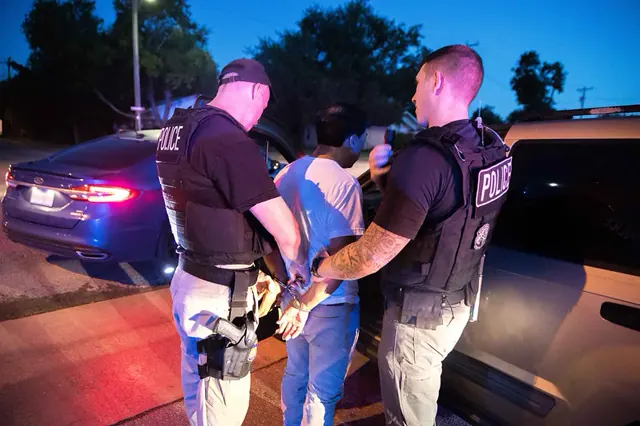




Immigration enforcement is now reaching the school conversation without needing a raid at the front door.
The issue is not whether immigration law should be enforced. It should be. The practical question for school districts is what happens when enforcement pressure, legal uncertainty, and family fear start changing attendance, enrollment, transportation, and parent participation.
That is where immigration policy becomes an education story.
Quick Read
- DHS rescinded Biden-era protected-area guidance in January 2025 for locations including schools and churches.
- The Washington Post reported April 12 that D.C. public school lottery applications fell for the 2026 to 2027 school year, including a 14 percent drop in pre-K applications and steeper drops in Spanish-dominant dual-language programs.
- The Texas Tribune reported April 2 that Texas has moved to limit access for undocumented immigrants and some noncitizens across school, work, licensing, and driving systems.
- A federal judge in Minnesota denied a request on May 7 to block immigration enforcement near schools in that case, showing the legal fight is still live.
- K-12 public school access still sits under Plyler v. Doe unless the law changes.
Recent Developments
On January 21, 2025, DHS announced it had ended the Biden-era protected-areas policy that had limited immigration enforcement in or near schools, churches, hospitals, and similar locations.
In February, two Minnesota school districts and Education Minnesota filed a federal lawsuit challenging that change. FOX 9 reported that the lawsuit was filed February 4 and argued that enforcement near schools disrupts education and creates fear.
On April 2, the Texas Tribune reported that Texas had moved across several systems affecting undocumented immigrants and some noncitizens, including higher education, occupational licensing, work access, and driving.
On April 12, the Washington Post reported that D.C. public school lottery applications had fallen for the 2026 to 2027 school year, with a 14 percent drop in pre-K applications and larger drops in Spanish-dominant dual-language programs.
On May 7, CBS Minnesota reported that a federal judge denied a request for a preliminary injunction that would have blocked immigration enforcement activity near public school grounds in Minnesota while the case continues.
That is the live issue: schools should not become shields from lawful enforcement, but districts also need written procedures before the question reaches a front office, a bus stop, or a principal’s desk.
The School Effect
The Washington Post reported April 12 that applications through Washington, D.C.’s public school lottery dropped for the 2026 to 2027 school year. The report said pre-K applications were down 14 percent and Spanish-dominant dual-language programs saw drops near 25 percent.
That does not prove every family made the same decision for the same reason. It does show a pattern districts should watch: immigration pressure can affect enrollment behavior before a school ever sees a formal enforcement action.
Brookings made a similar point in April, arguing that enforcement pressure can destabilize school participation for immigrant-origin students.
If families withdraw from normal school routines, attendance shifts, enrollment projections get weaker, English learner planning becomes harder, and parent contact becomes less reliable.
K-12 public school access still sits under the U.S. Supreme Court’s 1982 decision in Plyler v. Doe.
That means districts cannot operate as if that precedent does not exist. The question is how they keep campuses focused on education while immigration enforcement, student records, attendance, transportation, and law-enforcement requests become more politically charged.
The Texas Angle
Texas is already moving in a different direction than states and districts that have tried to wall off local institutions from federal enforcement.
The Texas Tribune reported April 2 that Texas has advanced legal and regulatory changes affecting undocumented immigrants and some noncitizens across higher education, occupational licensing, driving, and work access.
School systems do not exist apart from daily life. If a parent cannot drive legally, work legally, renew a license, or understand what rules apply next, that instability can show up in school attendance and family communication.
The answer is to be honest about the cost of disorder.
Illegal immigration creates pressure on classrooms, public budgets, housing, hospitals, wages, roads, and local services. It also creates uncertainty for children who did not write the laws.
Both things can be true.
The Taxpayer Question
Public schools are taxpayer-funded institutions.
Residents have a right to ask basic questions. How many students are districts planning for? How much does language support cost? How does absenteeism affect funding? How should schools handle federal enforcement requests? What records are protected?
Districts that avoid them leave parents, teachers, and taxpayers in the dark. Districts that turn them into activist slogans lose trust from residents who want law, order, and straight answers.
What Districts Should Do
The responsible path is simple.
Districts should follow the law, protect student records as required, cooperate with valid legal process, avoid obstructing federal enforcement, and keep campuses from becoming political staging grounds.
The courts are still sorting out pieces of this issue. The May 7 Minnesota ruling does not settle every legal question nationally, but it shows the fight over schools, enforcement, and boundaries is active now.
Why Local Readers Should Care
Collin County is growing quickly.
Prosper, Celina, Anna, Melissa, and Princeton are adding families, schools, roads, housing, and public-service demand at the same time. Immigration policy adds another layer to districts already dealing with growth, staffing, traffic, and enrollment planning.
Bottom Line
Immigration enforcement belongs in a lawful country.
Public schools belong to taxpayers and families.
The problem begins when schools are forced to absorb the consequences of a broken immigration system while political leaders pretend the tradeoffs do not exist. The standard should be order: enforce the law, protect classrooms, tell taxpayers the truth, and keep schools focused on education.