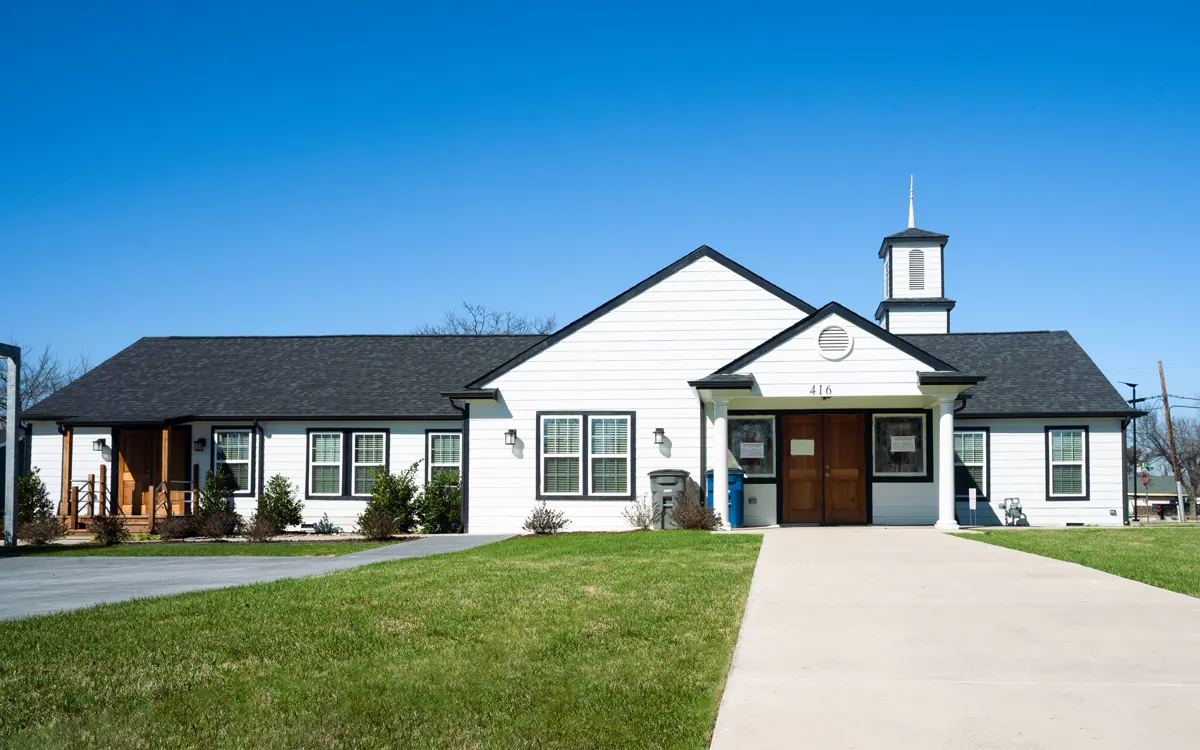




Imagine your town has an old building.
The town spends a lot of money to fix it.
Later, people start asking:
“Did we fix it correctly?”
“Did we spend the money the right way?”
So the town hires outside investigators to check.
That is what happened here.
What Building Are We Talking About?
The Steven and Judy Deffibaugh Community Center.
It used to be an old church building.
The city used public money to renovate it so the community could use it.
Why Did They Hire Investigators?
Some residents were worried about:
• how the money was spent
• whether the foundation was properly repaired
• whether contractors were selected correctly
So the city hired an outside firm called Weaver to review things.
Weaver is an accounting and forensic investigation company.
Their job was to look at documents and answer specific questions.
What Did Weaver Actually Do?
They completed something called Phase One.
Phase One was a limited review.
It was not a full deep investigation.
It was a first layer.
They wrote a three-page document called:
“Phase 1 Closeout Items and Preliminary Findings.”
That document is the official public record of their findings.
There is no longer report beyond that Phase One memo.
No Phase Two report was created.
What Questions Did Phase One Try to Answer?
Weaver focused on five main questions:
- Did the original renovation plans call for major foundation repair?
- After renovation, did the foundation still show problems?
- Did the city have official rules about hiring contractors?
- Did the city follow those rules for large contractors?
- Did the city keep spending large amounts fixing floors afterward?
That is it.
They were not investigating everything.
They were answering those specific questions.
What Did They Find?
1. Yes, the plans called for serious foundation work
The 2019 architectural plans said the building needed leveling and structural support work.
This was not cosmetic work.
It was meant to stabilize the building.
2. Years later, the foundation still showed problems
In December 2024, a foundation inspection found:
• cracks
• floor slope
• structural movement
That means that after renovation, the building still had foundation issues.
It does not automatically mean someone did something wrong.
It does mean the building was still not fully stable.
3. The city had spending rules
In 2019, the city adopted official purchasing policies.
That means rules existed for how to hire contractors and spend money.
4. Three major vendors were reviewed
Weaver looked at vendors paid over $50,000.
Here is what they found.
Vendor One: Mike Rodgers Construction
About $609,767 was paid.
Weaver found documentation of competitive bidding and formal approval.
On paper, the process followed the rules.
Vendor Two: DFW Framing and Construction
About $201,708 was paid.
Weaver found:
• no documented competitive bidding evidence
• multiple smaller contracts that together totaled over $50,000
• a recommendation that more review would be needed to fully analyze the contracts
Weaver did not say rules were intentionally broken.
They said documentation was incomplete and that more work would clarify the issue.
Vendor Three: Kimley-Horn & Associates
About $89,621 was paid.
Because this is a professional services firm, state law does not allow cities to choose them based only on lowest price.
Weaver found no documented formal qualifications process.
They recommended stronger documentation in the future.
5. They did not find repeated major floor repair spending
Weaver checked for large ongoing expenses fixing floors.
They did not see significant repeated flooring repair costs in the records they reviewed.
What Weaver Suggested Next
At the end of Phase One, Weaver listed additional steps they could take in Phase Two.
Phase Two would have included:
• reviewing internal emails
• reconstructing the full decision timeline
• looking for possible commingling of funds
• examining possible preferential vendor treatment
• interviewing architects and engineers
• producing a full formal forensic audit report
Phase Two required additional approval and funding.
It was optional.
What Happened Next?
On February 18, 2026, the Princeton Community Development Corporation reviewed the Phase One report.
After discussion, the board voted unanimously that no further research was needed.
Phase Two was not approved.
The investigation ended at Phase One.
There is no publicly available Phase Two report because it was never commissioned.
What This Means
Here is the story in plain language:
• the city spent public money to fix a building
• the foundation still showed problems later
• one contractor appears to have clear bidding documentation
• one contractor’s documentation appears incomplete and would have needed further review to clarify
• the investigators suggested deeper digging
• the board chose not to continue digging
That is the full, documented story as of today.
What This Does Not Mean
It does not mean:
• theft was proven
• corruption was proven
• rules were intentionally broken
The Phase One memo does not make those conclusions.
It identifies findings and suggests further steps.
The governing board decided not to pursue those further steps.
The Core Public Question
The real question is not:
“Was there corruption?”
The real question is:
“Was Phase One enough?”
That is a policy decision.
And it is now a public trust issue.